
Summer in AZ: Hot Temps and Cool Birds

Updated: Sep 7
Every birder knows about SE Arizona and the stunning birds that can be spotted there, but hearing that August is the ideal time to visit takes some suspension of disbelief. The day Rohn and I arrived in Tucson in early August, it was 106 degrees F. I birded for about 45 minutes at our first stop before feeling lightheaded and heading to the car for electrolytes. Why did I sign up for 8 days of this?

Why? Because in the end, I saw 34 new bird species that I had never seen before. I hiked up scenic canyons along monsoon-filled creeks, ate apples that I picked straight off the tree in a bird-filled orchard, enjoyed cool mornings followed by afternoon rain showers, and was surrounded by 100's of hummingbirds sparkling like jewelry when the sun hit them. By the end of the trip, I was on Zillow checking real estate listings for Patagonia, Bisbee and Portal, Arizona. The beauty of the mountainous areas between Tucson and the border with Mexico delighted all of us and had me vowing to return soon.

Rohn and I would never have dreamed up this trip on our own. But the Panhandle Bird Club has grown to more than 180 members since our first meeting in November 2024. Our membership includes expert birders like Hap Hamous and Tom Johnson, who have visited this part of SE Arizona several times. They were gracious enough to plan the trip, find the hotels, secure the guides, and locate the birding hotspots once we got there. On top of that, these two 70+ year olds can hike higher, identify more birds and endure longer days than the club members who are half their ages.
I did warn them ahead of time that I wasn't going to participate in any of the 10-hour "death marches" that they fondly recount from other birding trips that they have taken together. In most cases, Hap and Tom planned days on this trip that we could all enjoy (although that one drive over the mountain on the worst road I've ever traveled to find a couple of flycatchers was a surprise. Thank goodness for high-clearance, 4-wheel drive vehicles!).

Even without any death marches, the lifer birds started accumulating quickly on the first full day of birding on Mount Lemmon. Our guide, Jake Thompson, was a Houdini, pulling target birds out of every tree and hillside as we ascended the mountain that lies only 30 minutes north of Tucson. I got to see a warbler that I have always wanted to see--the Red-faced Warbler. While most warblers have yellow, black or olive coloring, this cute guy has a bright red face.

In addition to that warbler, we also saw a Hermit Warbler, Olive Warbler, Grace's Warbler, Painted Redstart, Townsend's Warbler, Black-throated Gray Warbler and Wilson's Warblers on Mount Lemmon. Since warblers dart around quickly at the tops of trees, we were craning our necks and constantly checking our peripheral vision. Weighed down by an 8-pound camera and lens, plus my binoculars, I definitely experienced "warbler neck", but I hardly cared. I was in the moment, enjoying the vibrant show, and didn't mind if a few Advil would be required that evening.

Of course, warblers weren't the only great birds we saw that day. Yellow-eyed Juncos were everywhere. All three woodpecker species that birders want to see in Arizona showed up for us -- Arizona Woodpecker, Gilded Flicker, and Gila Woodpecker. A Greater Pewee posed perfectly on a snag and 150 White-throated Swifts cruised over the lake near the top of the mountain while a pair of Mexican Ducks floated nearby.

A tradition in birding is that when you see a new bird species for the first time ("a lifer"), you eat pie. We are not the kind of people to disregard important traditions, so we found a great restaurant on Mount Lemmon to celebrate.

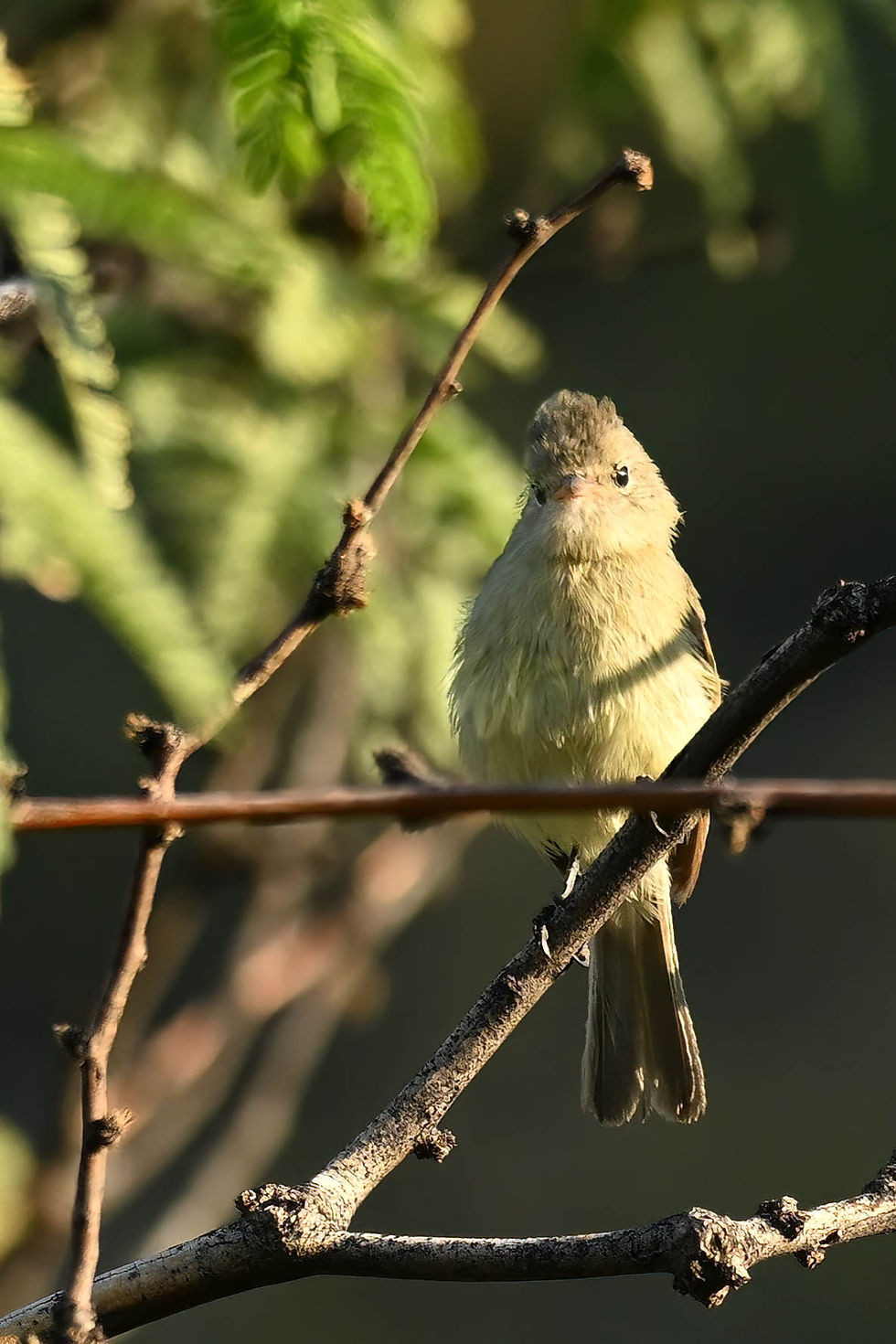
Then we headed south towards Madera Canyon, Patagonia, and Sierra Vista for several days, where we continued to pick up more lifer birds. Some were more subdued rarities, like Five-Striped Sparrow, Rufous-winged Sparrow, Botteri's Sparrow, and Northern Beardless Tyrannulet (which despite the fearsome name, is a fluffy little BIRB).
And then we hit hummingbird country. These beauties are the reason many people come to Arizona even when they are not necessarily crazy birders like us. Hummingbirds species show up here that are rarely found in any other area of the U.S. There are bird sanctuaries all over this mountainous wonderland that keep feeders full of sugar water for the hummers. Santa Rita Lodge, Ash Canyon Sanctuary, Paton House, Beatty's, Ramsey Canyon, and Cave Creek Ranch were just a few of the sanctuaries that provided chairs, benches, even bleachers for birdwatchers and photographers to enjoy the neverending parade of flashy hummers. We also drove up to individual homes where the residents set up feeders and patio furniture and then invited random strangers to take pictures and enjoy. Almost all of these places were free, although we always left cash in the donation boxes to help offset the cost of bird feed and sugar.
The Nature Conservancy's Ramsey Canyon preserve was especially a treat. The staff discovered a tiny Violet-crowned Hummingbird nest near their visitor's center and set up a spotting scope so that everyone could get a better look.

The hiking in Ramsey Canyon was exhilerating, taking us back in time past cabins from early 1900's settlers and 70' Arizona sycamores that were more than 100 years old. The weather was perfect and the birds cooperative.

Another lively hike took place at Beatty's Guest Ranch, Apiary and Orchard near Sierra Vista. Mr. Beatty owns an old apple orchard and homestead on a mountainside where hummingbirds congregate and creeks flow down canyons full of migrating birds. The hillsides were blissfully cool after a monsoon storm overnight. We were greeted by 17 Redbone Coonhounds, sampled the apples and the giant peaches, watched as the owner corralled a couple of rattlesnakes for removal to another canyon, and photographed the hummers from the bleachers set up for that purpose

Of course, when hummingbirds are attracted by running water, feeders and cover, so are other birds. We saw many other beauties along with the main attraction of hummingbirds in the many sanctuaries that we visited.


The sanctuaries provided great ideas of different ways to set up a yard that attracts birds. More is definitely better if these sanctuaries are any indication. But the sanctuaries also gave us respite to talk, laugh, and enjoy our time together with like-minded nature lovers.
Of course, there were many unforgettable moments with the entertaining folks of the Panhandle Bird Club. None who were on the trip will soon forget Hap's total domination of the Five Crowns card game, eating crisp Schnitzel at the German restaurant in Sierra Vista (twice), or witnessing the Great Spotting Scope Debate of 2026, which was capped off by the unlatched hatch of an SUV depositing Tom and Hap's luggage onto a dirt road near Patagonia.

Sadly, most of the crew had to return to the Texas Panhandle before the remaining six of us went to Portal, Arizona to end the trip by exploring the Chiricahuas. I'm sorry that the other eight missed this highlight. Rohn did some of his summer field work for his geology degree in this area, but even he didn't remember how enthralling this mountain range is.

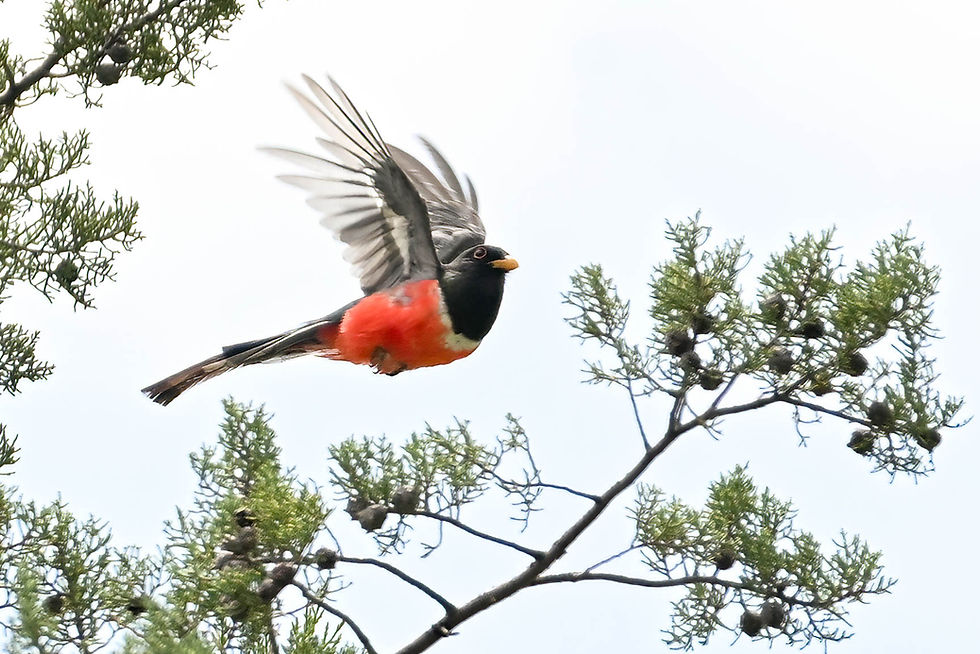
The target bird in this area has to be the Coppery-tailed Trogon (formerly called the Elegant Trogon). This very rare bird is generally only seen in the USA in this corner of Arizona. This 12" bird with the colors of Christmas (red, green and white) is so elusive that most birders have never seen it even in Arizona. But we got lucky. We were told that four Trogon pairs had nested along the South Fork trail in the Coronado National Forest this summer and that the families were still together. Listening for their distinctive croak helps to locate them. And locate them we did! At first, I could only capture the bird nestled behind branches in a tall evergreen. I thought that I would have to be satisfied with a photo that identified the bird, but certainly didn't do it justice. But then he burst out of the tree and I was miraculously able to take a couple of flight shots, including the cover shot for this blog post (which may be one of the best bird photos I've ever taken while completely unprepared).
Along that same trail, we also photographed a Sulphur-bellied Flycatcher drying out in the early morning light. Another lifer bird for me, but pie was not easy to locate in the tiny town of Portal, because it did not even contain a gas station. Fortunately, the town did feature one cafe/general store with delicious food, because as Andrea Gerig often reminds us, "Birding is hard work!"

I know I am starting to become repetitive in this blog about how unexpectedly beautiful SE Arizona is, but the South Fork trail was particularly inspiring. We actually hiked it on two separate days, one when the creek was dry and Rohn was able to walk in the creek bed to spot one of the Trogons, and then the day after a summer flash flood filled the creek.
The flash flood also filled the creek behind our rustic cabin at Cave Creek Ranch in Portal. Watching the creek fill up was both fascinating and frightening for us Texans (after the Camp Mystic tragedy), but we kept a close eye on how much it was rising and all was well. Here are the before and after photos that Cathy Back took. About a quarter-hour was all that was necessary for the creek to rise to those levels.
Cave Creek Ranch has been catering to birders for years. It isn't fancy, but we did have a cabin with a full kitchen and a back porch from where we could watch the creek fill up. The ranch staff provided bird seed in each room and a feeder on every patio. Even better, the area near the office attracts all kinds of birds. I watched Inca Doves doing mating dances, Acorn Woodpeckers feeding their young, bright yellow Hooded Orioles snacking on suet, all with the backdrop of the sunset-colored cliffs of the Chiricahuas.


I could have stayed much longer in Portal, even though I needed to get home to our lonely dogs, our heat-stressed garden and my clients who were patiently waiting for me to finish employment law projects for them. But I couldn't leave without one more view of the mountains and a promise to return as soon as we can.


Comments